
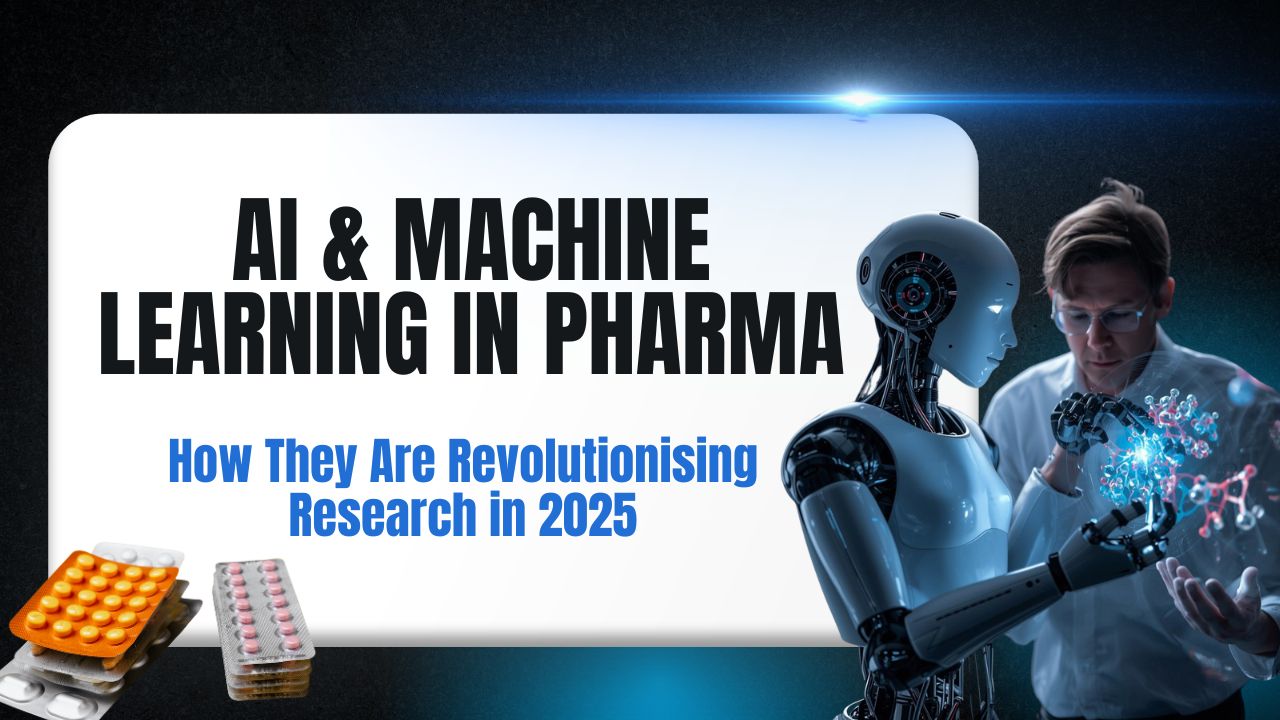
AI & Machine Learning in Pharma: How They Are Revolutionising Research in 2025
When we look back a few decades, it took 10-15 years to discover a single new drug and cost billions of dollars. Scientists would spend years in labs, testing thousands of compounds, and most of which would fail. This scenario is like searching for a needle in a haystack, and the haystack is the size of a football field. In recent years, AI & Machine Learning have transformed this process, making it more efficient and targeted. And most importantly, we aren’t even sure if the needle exists.
Now, it’s 2025, and there are some amazing things happening in the pharma industry. Artificial Intelligence and Machine Learning aren’t just changing the pharmaceutical industry; they’re completely changing the way things work. This rapid shift shows how AI & Machine Learning are becoming the backbone of innovation in modern pharma
Overview of AI & Machine Learning
Now, let us look at the bigger picture. The global market for AI in Pharmaceutical Industry has reached $1.94 billion in 2025 and by 2034. It is also expected to grow to approximately $16.49 billion. These statistics tell us one thing very clearly, that is, the pharmaceutical companies are relying big on AI, and this time it is for good reason. Do you know, it is also expected that AI will generate between $350 billion-$410 billion yearly for the pharmaceutical sector by 2025. This transformation is driven largely by AI & Machine Learning, which are helping companies work faster and smarter
By now, there will be one question in your mind which is, what it actually means for you in this pharma sector. This article will break the answers down for you. If you are a pharmacy student, a recent graduate, or a young professional trying to understand where and how the industry is growing, this article will be an eye-opener for you.
Understanding AI
We are all in the AI era now, and it’s very important to be aware that AI is ruling the world. Before we go deeper into the content, let’s understand what we mean by AI and Machine Learning (ML), especially in pharma. Today, AI in Pharma is helping researchers analyse complex biological data faster than ever
Artificial Intelligence – To put it in simple terms, it is teaching computers to think and make decisions like humans. But the process is much faster and has the ability to process large amounts of data that would take years for us humans to analyze.
Machine Learning is a subset of AI where algorithms learn from data patterns and improve their predictions over time without being specifically programmed for every scenario. To understand it better, think of it like teaching a child to recognize animals, after seeing a lot of pictures. Now, they can identify a cat even if they’ve never seen that specific cat before.
Deep Learning takes this to the next level, using complex neural networks inspired by the human brain to recognize minute patterns in data.
In recent times, there have been a lot of revolutions happening, and that is where it gets exciting for the pharma sector.
Revolution 1: Drug Discovery
We saw a needle and haystack scenario above and now AI is making it into a problem that can be managed well.
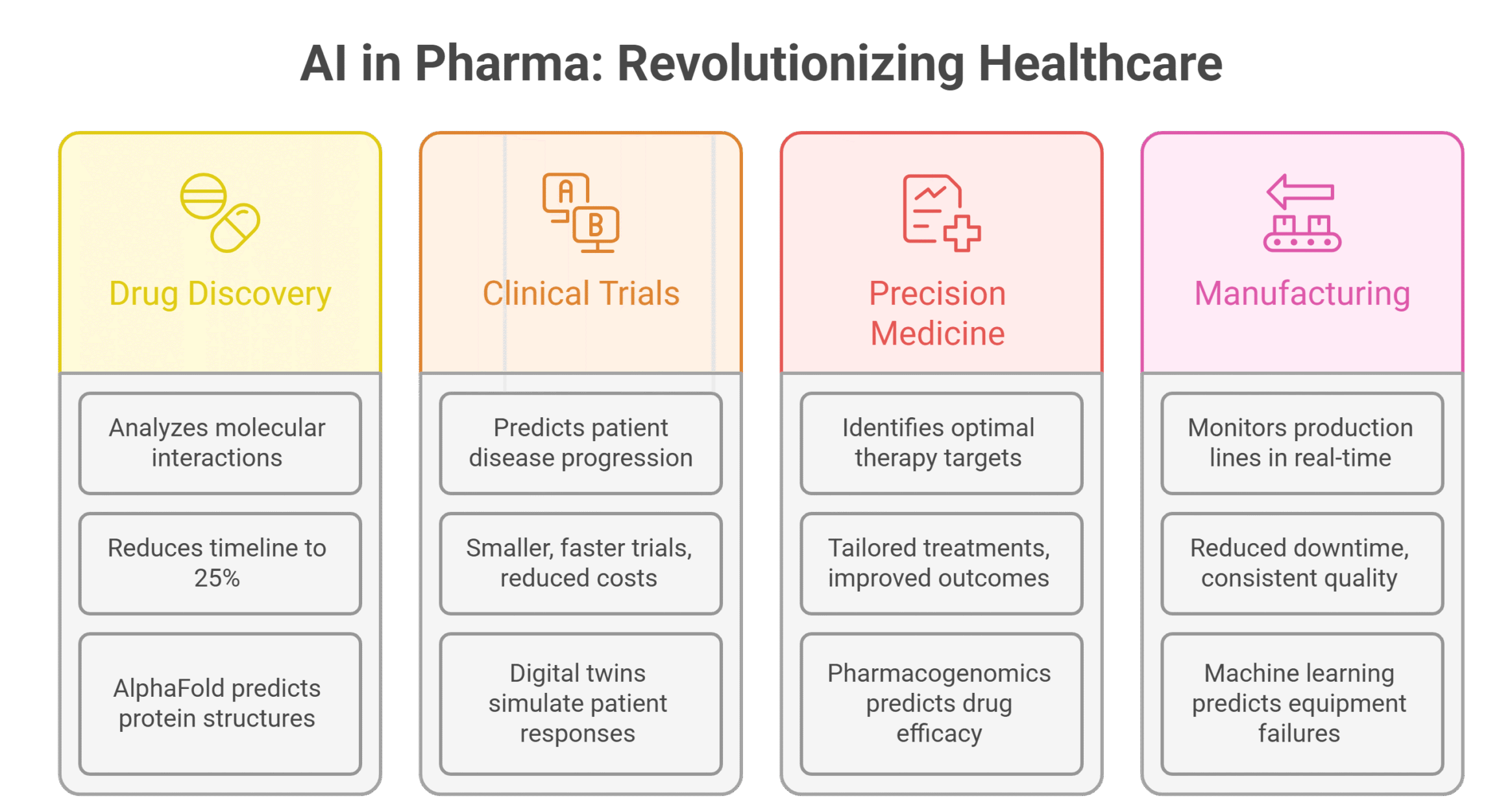
Traditionally, the drug discovery process was carried out by screening thousands or even millions of chemical compounds just to identify one promising drug candidate. This timeline is now reduced to 25% and all this was possible because of AI. All these now lead to one thing that potential life-saving drugs will now reach patients much earlier and more easily than before.
Tools like AlphaFold prove how AI & Machine Learning can analyse molecular interactions with unmatched accuracy. This was developed by Google DeepMind and can predict the structure and interactions of proteins, DNA, RNA, and small molecules with a lot of accuracy that we have never seen before. Things that scientists did with so much laboratory work, like identifying how a protein folds and how drugs will interact with it can now be done in a few seconds.
To explain it in simple terms, imagine you’re trying to design a key to fit a very complex lock, but you’ve never seen the lock mechanism. Previously, you would have to try thousands of key shapes until one worked. Now, AI can easily “see” inside the lock and tell you what shape the key needs to be.
AlphaFold 2 is already being used by millions of researchers, and there are a lot of discoveries being made in areas like malaria vaccines, cancer treatments, and enzyme design. The newer AlphaFold 3 goes even further, and it understands how different molecules interact with each other which is very important for designing drugs that work effectively in the human body.
Revolution 2: Clinical Trials Get Smarter
In the drug discovery process, clinical trials have always been the most expensive and time-consuming part of drug development. And another important thing is that is where most of the drugs fail. But 2025 has brought some amazing innovations.
Digital Twins
One of the most interesting developments in 2025 is the use of “digital twins” in clinical trials. Digital twins are AI-driven models that predict how a patient’s disease may progress over time. These digital twins are powered by AI & Machine Learning, simulating patient responses with remarkable precision.
Let us look at how it works: When a patient enrolls in a clinical trial, AI creates a virtual version of that patient based on their medical history, genetics, and other data. This digital twin predicts what would happen if the patient received a placebo instead of the actual drug. Isn’t it cool that AI is taking Science to the next level?
Digital twins help patients to receive treatments according to their preference over a placebo, and the sample size of the placebo arm is reduced by the sponsors. This is done so that more people can receive treatment. In short, it tells us that:
- Trials can be smaller and faster
- More patients get the actual treatment instead of a placebo
- We can make better go/no-go decisions earlier, and it saves a lot of resources.
- Clinical trial costs can be reduced by up to 70%
Here is an analogy: Imagine you’re a patient with a serious disease and you are enrolling in a clinical trial. In the old model, you had maybe a 50% chance of getting the placebo and receiving no treatment. With digital twins, those difficulties are shifted in your favor.
Better Patient Recruitment
AI machine learning models analyze large amounts of Electronic Health Records, identifying eligible participants who can take part in the tria,l and it does this with high accuracy. Tools like TrialGPT can match patients to suitable trials based on their medical histories and even predict which patients might drop out. This helps in preventing the disruptions of the trial.
For you as a future pharma professional, this means trials are more likely to succeed, and drugs will reach patients faster.
Revolution 3: Precision Medicine Becomes Real
AI gets to the next level, and here is where it adds a lot of value in healthcare.
Through genomic and proteomic data analysis, AI helps to identify optimal therapy targets and design individualized treatment plans. It does all these by analyzing patient genetic data along with their medical history. This is one of the areas where AI in Pharma creates the biggest impact—by tailoring treatments to unique patients.
Think about it: two patients with the same disease might respond completely differently to the same drug. One might get better while the other experiences severe side effects. Have you wondered why? It is because their genetic makeup is different.
AI combined with pharmacogenomics can predict drug efficacy and side effects for individual patients. And a few reports show that it can improve outcomes by 40% and the treatment cost will be reduced by 25%.
What this means for your career: In future, pharmacists or pharmaceutical scientists won’t just think about “a drug for a disease”, they’ll think about “the right drug for this specific person.” That’s a fundamentally different and much more exciting approach to medicine.
Revolution 4: AI Upgraded Manufacturing
Most of the time, we only see drug discovery get all the attention in the pharma sector. But we should also know that AI is transforming pharmaceutical manufacturing in so many other ways that matter.
There are machine learning algorithms that can now monitor production lines in real-time. It also predicts equipment failures before they happen. Early adopters report that there is a 30-50% reduction in equipment downtime. This means:
- There are very less production delays
- The quality of the drug is more consistent
- Lower manufacturing costs (which hopefully translate to more affordable medicines)
Companies that are leading this change
We can easily talk about the potential of AI and Machine learning, but to see it actionable, it is a different story. There are so many pharmaceutical companies that have started using AI in 2025. These companies show how AI in Pharma is not a future concept—it’s happening right now. Let us look at a few real examples.
Pfizer has embraced AI through multiple partnerships. The development of COVID-19 treatments, including Paxlovid, was accelerated with the help of AI, and this stands as a huge achievement.
AstraZeneca uses AI in developing treatments for chronic kidney disease and pulmonary fibrosis. It is also using AI to enhance the drug discovery process and optimise clinical trial designs.
Janssen is leading with over 100 AI projects across clinical trials, patient recruitment, and drug discovery. Their Trials360.ai platform sets an example for how AI streamlines trial processes.
Roche topped the Statista AI readiness index in 2023. It also set the standard for AI adoption in pharma through both in-house talent and strategic acquisitions of technology-focused companies.
The Challenges in AI & Machine Learning
While AI in the Pharmaceutical Industry has enormous potential, it also comes with serious challenges. Now, let’s look at the reality. AI has revolutionized the pharma sector, but this doesn’t come without any challenges. It is equally important for us to understand these challenges to advance in this field.
The “Black Box” Problem
AI models are generally considered “black boxes,” making their conclusions challenging to understand. There is a lack of model transparency, hence their potential is also limited. When an AI recommends a particular drug molecule, it’s not always clear why it made that recommendation. This creates challenges for regulatory approval and scientific validation.
What is the role that you will play? As a future pharma professional, you’ll need to bridge the gap between AI predictions and biological understanding. The industry needs people who can interpret AI results, validate them experimentally, and explain them to regulators and clinicians. Prepare yourself and get into the field with confidence.
Quality of Data and Bias
AI’s data is directly related to the source it has learnt the information from. It is only as good as the data it learns from. If historical clinical trial data lacks diversity and most of the data includes details from one demographic group, then AI will not work well for everyone.
This is where young professionals like you can make a huge impact. You can do it by ensuring diverse data collection, questioning AI outputs, and supporting for inclusive drug development.
Looking at the Future of AI & Machine Learning
If you’re someone who is reading this as a student or young professional, you’re probably wondering: “How does this affect my future in pharma?”
There is some good news for you. This is the best time to enter pharmaceutical research. As AI in the Pharmaceutical Industry expands, new roles and skills are becoming essential
Here’s why you should consider choosing the pharma industry:
New Skill Sets Are Valued
The industry is in need of professionals who understand both pharmacy/biology and data science. You don’t need to become a computer scientist, but knowledge of AI concepts, data analysis, and computational tools will set you apart.
Faster Innovation Cycles
There is an industry leader who predicts that by 2025, the pharmaceutical industry will have fully embraced AI as a valuable tool. And it will drastically improve the efficiency of drug development, describing it as “an institutional industry revolution”. This means there will be more opportunities for innovation, more drugs in development, and more career paths opening up.
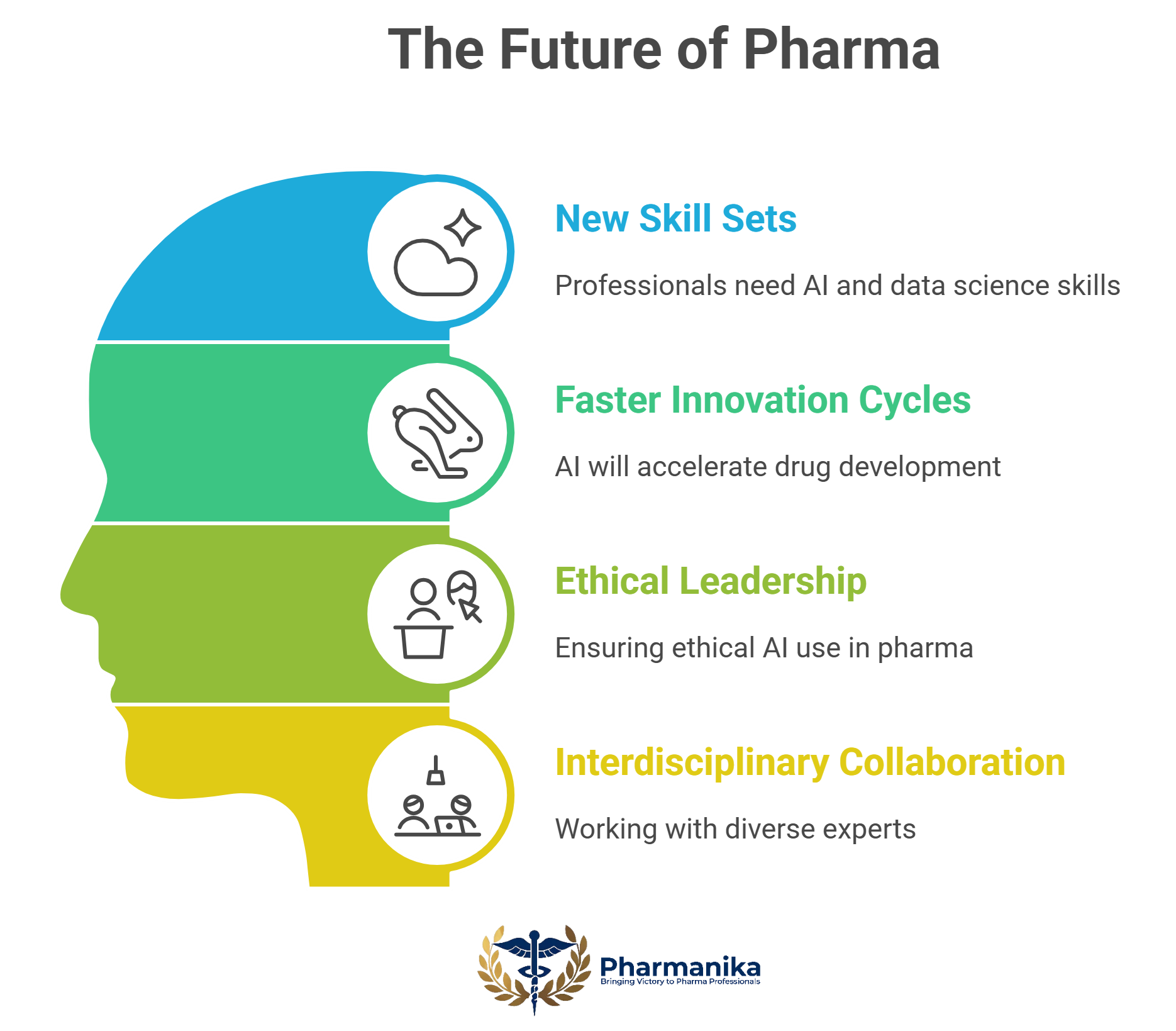
Ethical Leadership Opportunities
As AI becomes more popular, the industry needs people who can ensure it’s used ethically, equitably, and effectively. The next generation will shape how these tools are deployed and used wisely and effectively.
Interdisciplinary Collaboration
The future of pharma is at the intersection of multiple disciplines. You might find yourself working alongside data scientists, AI engineers, clinicians, and traditional pharmaceutical scientists. All of you will be collaborating to solve problems that were previously unsolvable.
Conclusion
We are in 2025, and we are already looking at great discoveries. AI and Machine Learning aren’t just making pharmaceutical research faster or cheaper; they’re making things possible that couldn’t be done before.
From predicting protein structures in seconds to creating digital twins of patients, from designing personalized medicines to spotting promising drug candidates among billions of possibilities, AI is expanding the boundaries of what pharmaceutical science can achieve. Pharma’s future will be shaped by those who understand how to use AI & Machine Learning responsibly and creatively
Though there are a lot of challenges, AI-driven drug discovery has substantially reduced development times and costs. This is expediting the process and reducing the financial risks of bringing new medicines to market.
For you as a student or young professional, this isn’t just the right time to observe; it’s a great time to participate. The pharmaceutical industry of 2025 needs passionate, curious minds who are willing to adapt to both traditional pharmaceutical knowledge and practical technology. That could be you. The revolution is here. The question is: are you ready to be part of it?