
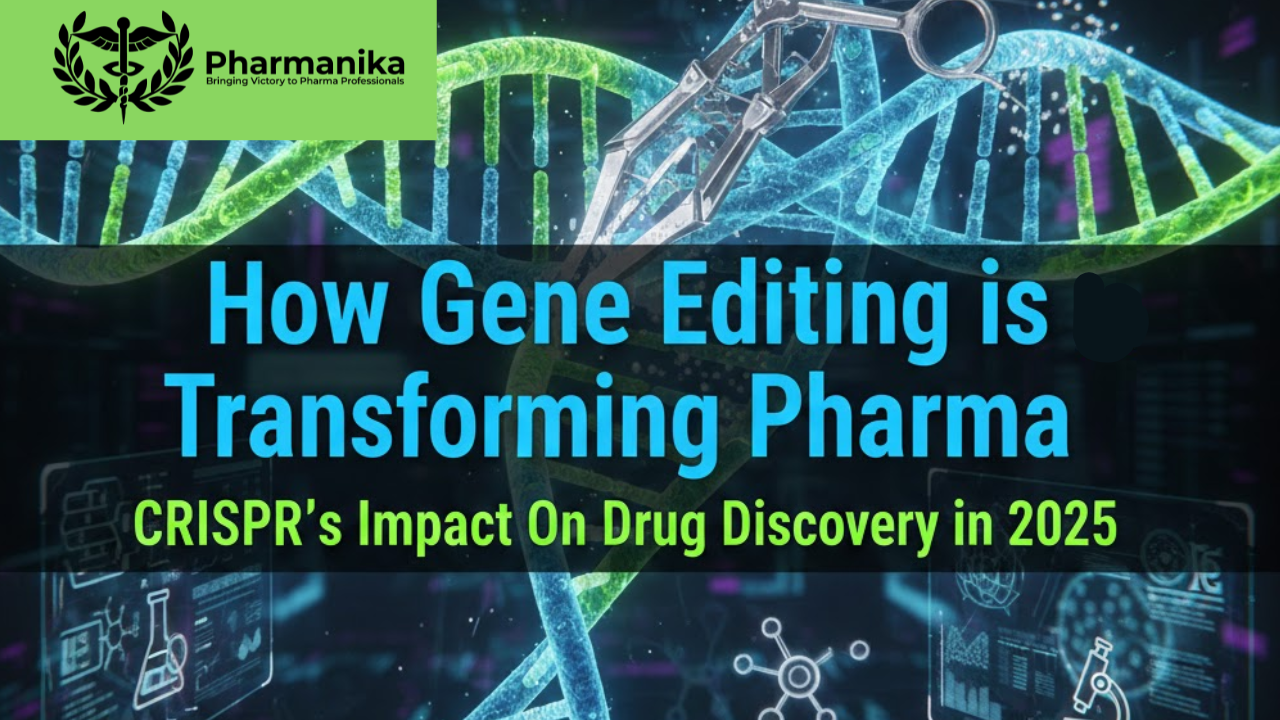
Role of CRISPR Gene Editing in Modern Drug Discovery
Imagine the future where there are no medicines to cure diseases and no symptom check is done to check what is causing the disease, but you know which gene is causing the disease, and it can be cut precisely, which will help us to overcome lifelong treatments. This is not just science fiction; instead, it is a real promise where gene editing, especially in Gene Editing CRISPR technology, plays a significant role in pharmaceutical research. The ability of the technology to cut, add, or modify the DNA without any mistakes but with precise accuracy is important, and it is transforming Drug Development, in precision medicine, and also in personalized therapeutics, which has a great impact on the future.
Introduction
The pharmaceutical industry has faced a lot of challenges, mainly in developing drugs that will work effectively in identifying the root cause of the disease and helping to cure the disease, particularly when it comes to generic components. The Gene Editing tool, which is CRISPR’s excellent capability to modify genes directly, provides a reward for research, which gives us innovative development of drugs that were impossible to do before. For students and fresh pharma graduates, it is important to grasp the new gene editing technology and be ready for the future of medicine.
What is CRISPR?
The new gene editing technology, which is the Gene Editing – CRISPR it stands for “Clustered Regularly Interspaced Short Palindromic Repeats.” The discovery of this outbreak is wherein it was a sequence which was found in bacterial DNA that helps bacteria defend against viruses. Scientists are so intelligent and clever that they adapted this system into a gene-editing tool, which was then paired with “guide RNA” with the CRISPR-associated protein enzyme, which is Cas9. So here the function is where the guide RNA is directing Cas9 to a precise location on the DNA strand, where the enzyme creates a cut in the gene.
This cut, which is made by the enzyme, helps scientists to damage the faulty gene, which deletes problematic DNA sections which creating problems in the DNA, or it can also function to insert or add a new genetic material for good therapeutic effect. As we all know, the previous gene-editing tools, such as TALENs or ZFNs, CRISPR is easier to program than the previous tools, and it is also highly efficient and also it is cost-effective, and it is more precise, which helps us to make the preferred tool in the pharmaceutical research.
CRISPR in Pharma: The Shift Towards Targeted Drug Discovery
There is a positive shift in pharma research where pharma researchers started using CRISPR to modify genes that are connected to a particular disease, which helps them to create accurate disease models which resulting in gene-edited cell lines, organoids, and animal models. The models that are created help to reproduce human disease which has high fidelity, and help in the rapid identification of drug targets, and help us to understand the disease mechanism better.
For example, when it comes to cancer research, the innovative CRISPR it generated tumor models, which enabled the researchers to study specific genes that are responsible for gene mutations that help in tumor growth. When it comes to rare genetic diseases and metabolic disorders, CRISPR helps us to study directly the corrections of mutations, which helps in supporting the development of targeted therapies, which helps in improving the patient outcomes faster than traditional methods.
2025 Breakthroughs: What’s New in CRISPR-Driven Drug Discovery
Let’s now look into 2025, which had new CRISPR technologies which including Prime Editing and Base Editing, which help to make gene edits easier and accurate it helping to avoid double-strand DNA breaks, which helps us in reducing off-target effects. CRISPR 3.0 combines all of these advances, where it has improved delivery methods such as lipid nanoparticles(LNPs), which help to transport all the CRISPR components safely through the body.
The editing of hundreds of genes to identify which are the changes that affect disease pathways, which helps in accelerating drug candidate discovery, is done by scientists with the help of High-throughput CRISPR. The integration of Artificial Intelligence (AI) helps us to further enhance precision by predicting optimal RNA sequences, which helps in minimizing errors and maximizing editing efficiency.
Gene Editing – CRISPR for Personalized Medicine: The Future-Tailored Treatment
In this revolutionizing healthcare era, personalized medicine is tailoring treatments to single genetic profiles. In patient-derived cells cultured in a lab where CRISPR technologies play a vital role, this helps the researchers to test how specific the drugs will interact with a patient’s unique genetic makeup before administering the therapy.
To predict patients’ responses, CRISPR-based biomarkers are helping, which allows clinicians to select the most effective drugs for patients. Some of the areas, like Cancer immunotherapy, benefit themselves through gene-edited immune cells, which are engineered to target tumors, whereas when it comes to gene-edited stem cells, they hold promise for repairing damaged tissues, which opens new frontiers in regenerative medicine.
CRISPR in RNA Targeting and Functional Genomics
As we all know, CRISPR helps us to cut DNA, but beyond everything, CRISPR technologies help us to modulate gene activity. When it comes to CRISPR interference (CRISPRi) main aim is to silence the gene expression, whereas in CRISPR activation (CRISPRa) enhances the expression. These are some of the tools that help scientists to study gene functions in detail by identifying the pathways that cause diseases.
To understand the gene function through CRISPRi/a, it guides us in drug development, which helps us uncover new therapeutic targets which resulting in deepening insights into molecular disease mechanisms and further helps to enable precise drug action evaluation.
Real-World Pharma Application in Gene Editing
Here are some of the case studies that we have to know which are real and have a good impact:
- Sickle Cell and Beta-Thalassemia Therapies
These are the therapies that were the first approved CRISPR treatments, which increase the fetal hemoglobin by editing the patients’ hematopoietic stem cells, which significantly helps in reducing disease danger and transfusion dependence.
2. Gene-Edited CAR-T Cell Therapy
In cancer research, CRISPR plays a significant role, which helps the CAR-T immunotherapy durability longer and the tumor cells, which has a revolutionary role in cancer treatment.
3. Neurodegenerative Disease Research
We know some diseases, such as Alzheimer’s and Parkinson’s, which don’t have a proper treatment yet, but CRISPR screens have identified new novel drug targets for these diseases, which help in new drug discovery.
4. Rare Disease Drug Development
In the preclinical evaluation of potential drugs related to rare genetic disorders, CRISPR-engineered models play a significant role.
How Pharma Companies Are Using CRISPR in 2025
Some of the leading industries, such as Novartis, CRISPR Therapeutics, Vertex, and Editas, are in a plan to introduce CRISPR-based drugs. Some of the collaborative efforts between the academic labs and the biotech start-ups, which are transforming discovery to market and investments in CRISPR platforms, will continue to grow globally, which helps in elaborating the clinical applications in hematology, oncology, neurology, and infectious diseases.
Benefits of Gene Editing – CRISPR in Drug Discovery
- Identification of Rapid drug targets from direct gene-function edits.
- In drug success, there are improved disease models that lead to higher predictive accuracy.
- Reduced development time and cost compared to traditional methods.
- Ethical advances by decreasing reliance on animal testing through precise gene editing
Challenges and Limitations: What students must understand
We all face some or the other challenges in our daily lives; in that case, even CRISPR has some challenges when it comes to safety concerns. The off-target edits risk the unintended genetic changes. We also have some of the ethical debates, which include those about germline editing, which has developed waste. When it comes to our body delivering CRISPR therapies efficiently inside our body remains complex with the viral vectors and the nanoparticles award limitations. We have another limitation, which is the high cost restriction on access, particularly in low-resource settings, which requires global policy attention.
Regulation and Safety for Gene Editing: What 2025 Guidelines Look Like
Some of the regulatory agencies across the world have updated frameworks to address the CRISPR therapy’s unique risk. So the drug approvals are based on the strong safety data from the early studies, should have transparent clinical trial plans, and finally, they should undergo strict ethical checks, which is done to protect patients and check if they have given informed consent. It is the company’s responsibility to prove that their systems can detect unwanted drug effects and show that the treatments work well in the long term.
CRISPR+AI+Automation: The Next Phase of Pharma Innovation
Now AI is also helping CRISPR. drug discovery by finding the best gene targets, and it also benefits by reducing the failure of experiments. The complex steps of CRISPR lab work are made simple by robots due to their speed. Have you heard of Digital Twins? They are the virtual models that were created from CRISPR and AI data. They help to predict how patients respond to treatments and help to design better and also help in faster clinical trials.
Future Outlook: What the Next 5 Years Could Look Like in Gene Editing (2025–2030)
So here the future has more advances, where the CRISPR-based medicines are expected to grow beyond the rare genetic diseases to treat the common ones, because they are the ones that get approved faster. So in the future, we can see gene editing vaccines, and there will be preventive measures in the treatments, which will become routine. When CRISPR is combined with nanomedicine, CRISPR plays a significant role in delivering treatments directly to the affected tissues, so it has the potential to cure many inherited diseases and has the potential to change medicine completely.
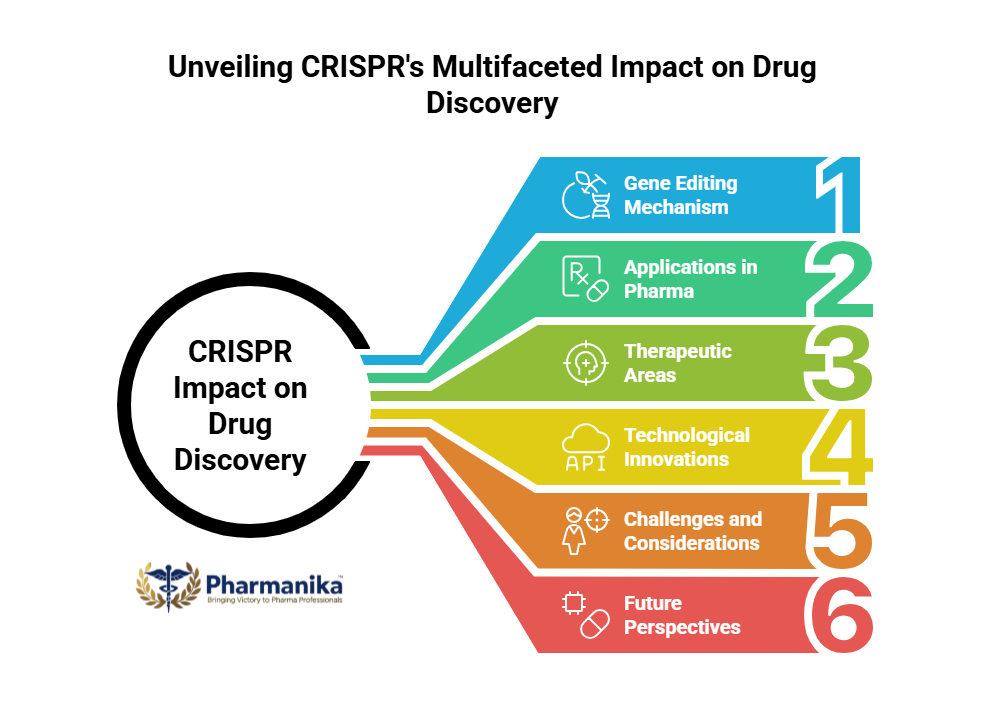
CRISPR Impact on Drug Discovery
Conclusion
There is a positive change in the pharmaceutical science by CRISPR by making Drug Development quicker, safer, and makes it more personalized. Students have to understand both sides of the great potential of it and the ethical issues it brings. So learning about CRISPR will help you to be future updated for the researchers in clinical research and healthcare workers, are the next big changes in the field of medicine.