

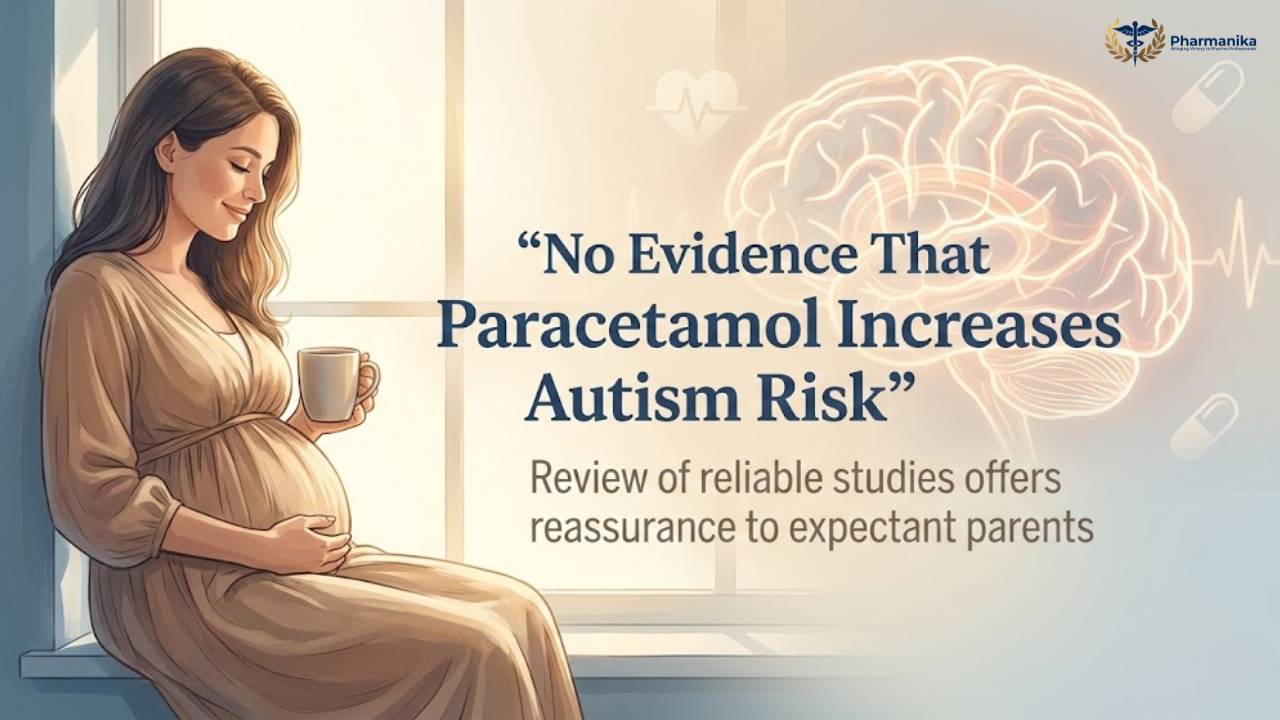
No evidence that paracetamol increases the risk of autism among children
What is the News About? Recently, there has been growing public concern and discussion regarding a possible paracetamol autism risk.
Of course, we all know how alarming those headlines in the early days were for expectant parents. This Paracetamol autism risk made a huge impact on the mothers. Well, when you’re pregnant, it always runs through your mind that you have to do everything right. Then, suddenly, people start saying that maybe a very common pain reliever is connected with autism or ADHD, which is alarming. But now let me tell you some good news, there is a huge new look at the research that has just come out. It is very reassuring. So let me tell you what the news is about and what really came out more simply.
Big News: Paracetamol Is Safe
A group of experts from the University of Liverpool and other schools located in other parts of Europe have been studying 43 different studies on this topic. They have now completed a study on it. What is their conclusion? What do they say about their study? “There is no real evidence that taking paracetamol during pregnancy causes autism, ADHD, or learning delays.
This is a big deal since it clears the minds of expecting mothers. It also helps doctors to clear up any confusion that might have been there regarding this issue.
Why was there this scare to begin with?
Well, for about 10 years, there were small-scale studies suggesting possible links to the children and the mothers who were taking paracetamol. This caused much consternation among the population, even though there was no change in formal clinical advice.
The issue with these previous studies was that they were examining the big picture. They noted that there were kids with ADHD and their mothers had taken paracetamol. But in reality, they didn’t really investigate enough to find out if there was actually a problem with the medication or if there was another underlying issue. So, mostly, they emphasized having sound research study designs, which are essentially the sibling comparison study designs. Within these studies, they made direct comparisons among the brothers and sisters sharing the same mother. In these cases, paracetamol was taken in the first pregnancy but not in the second.
Clear Findings based on high-quality evidence
Finally, after scrutinizing the data available, it was discovered that there is actually absolutely nothing significant about the correlation relating to taking paracetamol in pregnancy in connection with autism/ADHD or intellectual disability in children. The sibling study carried out actually discovered the fact that there was actually no connection in terms of increased autism risk in connection with taking paracetamol. This indicates that the initial warning was, in fact, due to something else.
What Earlier Studies May Have Missed
The researchers noted that many earlier studies did not adequately separate the effects of paracetamol from the conditions for which it was taken. Factors such as maternal fever, pain, infections, inflammation, or underlying genetic traits may themselves be associated with neurodevelopmental outcomes.
Without accounting for these variables, previous studies may have incorrectly attributed risk to paracetamol.
Independent Expert View
An independent researcher not involved in the study said the analysis is important because it tackles the problem of bias more effectively than earlier research. By focusing on higher-quality evidence, the findings provide a clearer and more reliable picture of the actual risk.
What This Means for Expectant Mothers
The findings support existing medical advice that paracetamol can be used during pregnancy when needed and taken as directed. Doctors continue to stress that untreated fever or severe pain during pregnancy can pose risks to both the mother and the developing baby.
The researchers conclude that current scientific evidence does not justify changing clinical recommendations regarding paracetamol use in pregnancy.