

Pharma Research Projects in College: A Hidden Path to Startups
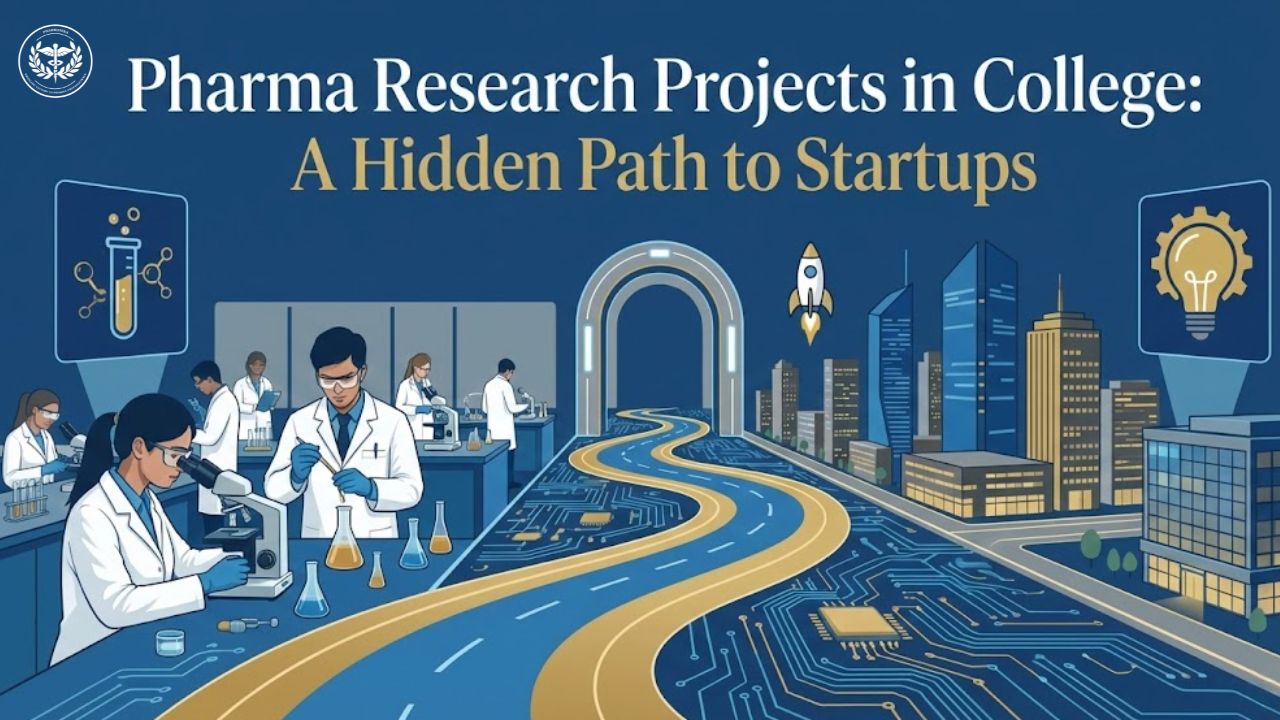
Most of the students treat their final year project as just another hurdle to cross to get that degree. They pick a topic or choose the topic that the PI gives, run experiments, write up results as a document, and move on with the next chapter. But no one has focused on thinking what if the project could be turned into something bigger. What if your college work became the base for a research project to startup journey?
Most of these ideas emerge in college, and they are not aware of their own potential. So many students in their final year work on problem statements that have the potential to solve real medical challenges. These pharma research projects are not just academic exercises; they can become real-world solutions. But all that we can see are piles of documents being dumped in the room, which is of no use. But on the other side, there are a few pharma companies that start this way. Someone decided to take the student project seriously, and it ended up becoming a big pharma company.
This article will help you understand how to move from pharma research projects to startup ideas and how this path can shape your career after pharmacy in a completely new direction.
The Real Stories
Real stories are the living proof. For instance, Moderna started from academic research on messenger RNA technology before it became a popular name in all households. The founders saw the potential in a lab-based project and transformed it into a research project to startup success story. If we look at another example of 23andMe, which started when Anne Wojcicki realized that genetic testing could move beyond research labs and get into people’s homes.
But these breakthroughs were not because of luck, and they did not happen overnight. These are the situations where people identified that research has potential beyond academia.
Why College Projects Work as Seeds for Startup
One big advantage of student research is that you will already be doing the hard part of the process. You will be identifying problems, testing solutions, and gathering all the required data. Many pharma research projects already have the foundation needed for innovation. There is good infrastructure, labs, equipment, mentors, and often some funding. During this, you will also be surrounded by bright people who might one day become your future co-founders.
There is another advantage in research projects. It has low pressure. Unlike corporate research, you can explore different ideas without worrying about quarterly earnings or investor demands. This will offer freedom to think and explore more, which will lead to breakthroughs. You can test the hypothesis that established companies would be considered too risky or too early-stage.
Universities are increasingly supportive these days of student entrepreneurship. The universities are now having incubators and conducting competitions for students to pitch their ideas. This will help them to commercialize their ideas.
There are so many universities that have specific incubators, pitch competitions, and programs specifically designed to help students commercialize their research. There are a few colleges that support students to turn projects into startups by having a dedicated fund.
Good Project vs Good Business
One thing to be understood is that not all research projects can be turned into a startup. It is important to be aware of what to look for in the projects. While doing a research project, ask yourself these questions. Does this solve a problem that people actually have? Is someone currently paying money to solve this problem? Will this work outside a highly controlled lab environment?
Often, the best startup ideas come from practical gaps. A cheaper diagnostic tool, a better drug delivery system, or affordable healthcare solutions can redefine your career after pharmacy and open new business paths. These practical solutions have more impact than groundbreaking research that has no proper application.
Another important factor to be considered is the timeline, as you know, the pharma sector moves slowly. It takes 10 years to bring one drug to the market. But not all pharma companies develop drugs. Some companies focus on devices, diagnostics, software for clinical trials, or tools that make existing treatments work better. These paths can be faster and less capital-intensive.
From Pharma Research Project to Startup
Converting your research into a business model is not as difficult as it sounds. Here is how you can turn your research ideas into business models
Understand and validate the problem
The first step is to talk to at least 20 people who are dealing with the problem that you are trying to solve. It can be doctors, patients, lab technician or the hospitals. If the problem is real, your research project or startup idea becomes stronger. If they are not attracted to the solution, then you should go back and work on your problem statement.
Get to know the University Rules
Understand and get to know who owns the intellectual property. Document everything and file the paperwork early. A few universities will have specific forms that you need to submit within days of a discovery.
- Build a small team
It is not possible to build it entirely by one person. You need people with different skills and ideas. Strong startups are built by teams – science, business, and regulatory together. This team approach can redefine your career after pharmacy from job-seeker to creator.
Find someone good in business, someone who can handle the regulatory aspects, and someone who understands science in depth. Most of the time you will find them as your classmates or seniors. Talk to them and form a strong team.
- Start with a basic plan
Don’t start working on your long-term goals. Start by building a basic business plan. Note down who your customers are and how much they would pay for your solution. You should also note how much you would spend to make the product and how you would make the product reach the people. This might sound fancy, but these are just a few pages of work. This will help you have a clear vision and think about everything.
- Get early Funding
Start looking for funding at an early stage. Apply for university grants, student business competitions, and government schemes for student entrepreneurs. There are a few schemes like BIRAC and Startup India that support pharma ventures at their early stages. Don’t bother about the win or lose, the application is sharpen your pitch.
- Use a simple version for testing
You don’t need to have a perfect product to start. Create a simpler version of the product that will still solve the problem, and you can test it with that. Get feedback from people, improve it and repeat the same until you achieve the final product. This approach will save a lot of time and money.
The Challenges
It all sounds really motivating and fun, but it comes with its own hurdles to deal with. It is not very easy to start a pharma company. It requires a lot of money, patience, and, more importantly, dealing with regulatory bodies. Even if you are very strong with science and pharma, you will have to learn other things that have nothing to do with science. Things like hiring, raising funds, marketing, and understanding legal requirements.
There will be a lot of skeptical thoughts. You will have to deal with questions like “Can students build serious companies?” A few questions might be fair. You don’t have years of industry experience, but you have the ability to bring new perspectives that make us wonder about how it has been done.
Another big challenge might be deciding between wanting to become a scientist or a businessman. If you are running a startup, it means that you will be spending less time in the bench doing research and more time in meetings and strategizing. You should be honest with yourself and decide according to what excites you.
Conclusion
If you are converting your research idea into a startup, and if it doesn’t work, it is completely fine. The overall experience will teach you things that none of the classrooms or textbooks would do. You will know how to pitch your ideas and even sell them. Most importantly, you will know how to handle failures and rejections. These skills are more important than the technical knowledge and will help you survive in the industry. These skills shape your career after pharmacy far beyond certificates.
You might not have been able to publish your idea as a research paper, but it would have become a product that will save millions of lives.
Your college research project doesn’t have to end with graduation. Sometimes, it’s just the beginning. If your idea has ever turned into a startup, share it in the comments.