


New Membrane Innovation Signals a Shift in the Pharmaceutical Industry
In the pharmaceutical Industry, Separation processes are very important. From purifying active Pharmaceutical Ingredients (APIs) to recovering solvents and treating the wastewater, separations decide the quality of the product. They also affect the cost and environmental impact. Yet, despite years of innovation, most of the industries still rely on energy-intensive technologies like distillation and evaporation.
In a recent collaborative research project involving CSIR- Central Salt and Marine Chemicals Research Institute (CSMCRI), IIT Gandhinagar, Nanyang Technological University (Singapore), and the S N Bose National Centre for Basic Sciences has invented a promising alternative to separation processes. Their work got published in the Journal of the American Chemical Society. It describes a new class of ultra-precise filtration membranes called ‘POMbranes”.
Why does separation remain a major problem?
It is estimated that 40-50% of the global industrial energy consumption is spent on the separation process in the following ways
- API Purification
- Removal of closely related impurities
- Solvent recovery
- Wastewater treatment
Membrane separation is often considered a cleaner option. But most of the polymer membranes used these days have irregular pore sizes. In addition, it is believed that they get degraded over time, especially under harsh chemical conditions. This limits their precision, durability, and suitability for high-value pharma drug applications.
What makes POMbranes different?
The key innovation behind POMbranes lies in their molecular structure.
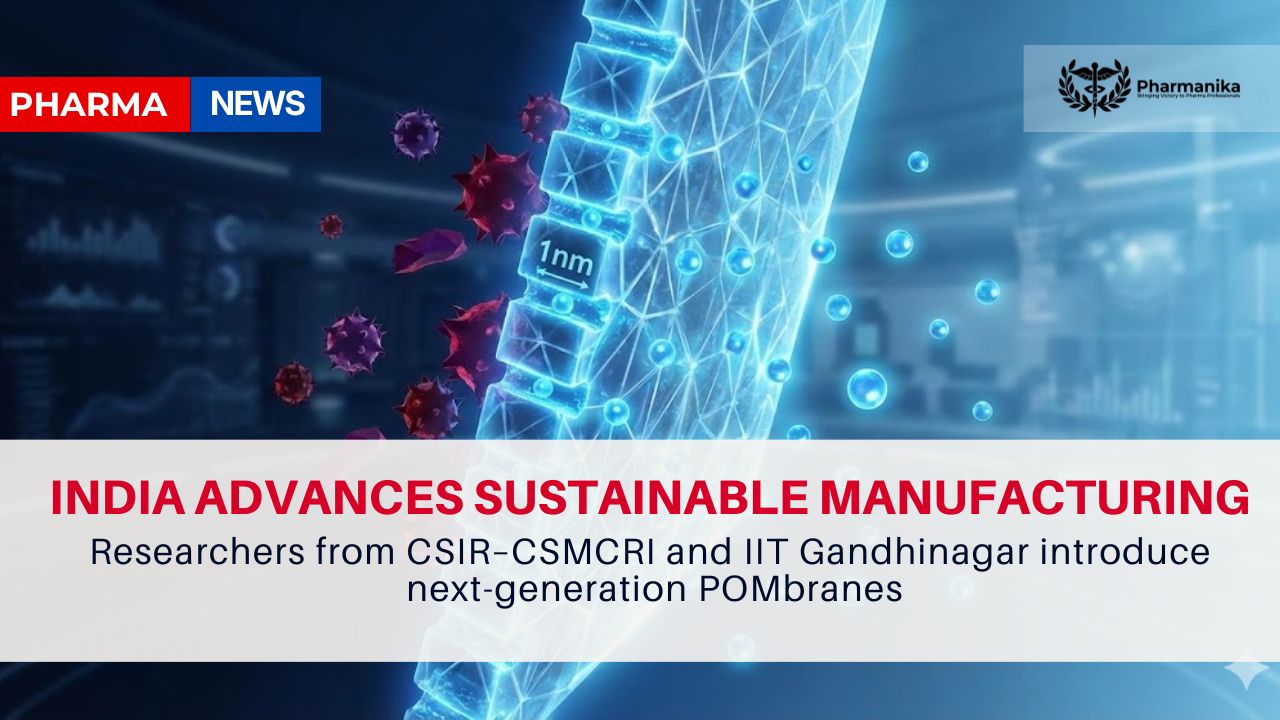
The researchers used Polyoxometalate(POM) clusters, which are nanoscale, crown-shaped metal clusters that naturally have a permanent central pore about one nanometer wide. These polymer membranes have:
- A fixed size
- Does not deform or collapse
- Maintains its structure over time
Interestingly, this approach is inspired by biology, where natural water channels like aquaporins depend on precisely sized pores to selectively allow molecules to pass through. POMbranes replicate this principle using inorganic chemistry.
To convert individual POM clusters into a usable membrane, the team attaches flexible chemical chains to them. When placed on water, these clusters spontaneously align and spread into a continuous, ultrathin film. By adjusting the chain length, researchers can fine-tune how tightly the clusters pack together. This forces the molecules to pass only through the 1-nanometer pores.
What makes this important for the pharmaceutical industry?
In research testing, POMbranes were able to separate molecules that differ in size by as little as 100-200 daltons, a level of accuracy that is rarely seen in conventional membranes. The membranes also showed nearly ten times better separation performance. Meanwhile, they remained flexible, stable across different pH levels, and scalable for industrial use.
For the pharmaceutical industry, this could mean:
- Cleaner drug purification
- More efficient solvent recovery
- Lower energy consumption
- Better Control over product quality
A step towards sustainable manufacturing
The pharmaceutical industries are economic pillars of India, but they are facing pressure to reduce water use, energy consumption, and environmental damage.
POMbranes offera balance between performance and practicality. This is a powerful example of how chemistry, material science, and engineering come together to solve real industrial problems, and it’s a signal to shift towards next-generation separation technologies, which prioritize sustainability.
As industries look for a way to do more with less energy, less water, and minimal emissions, innovations like POMbranes may soon move from the lab into the manufacturing plants.