
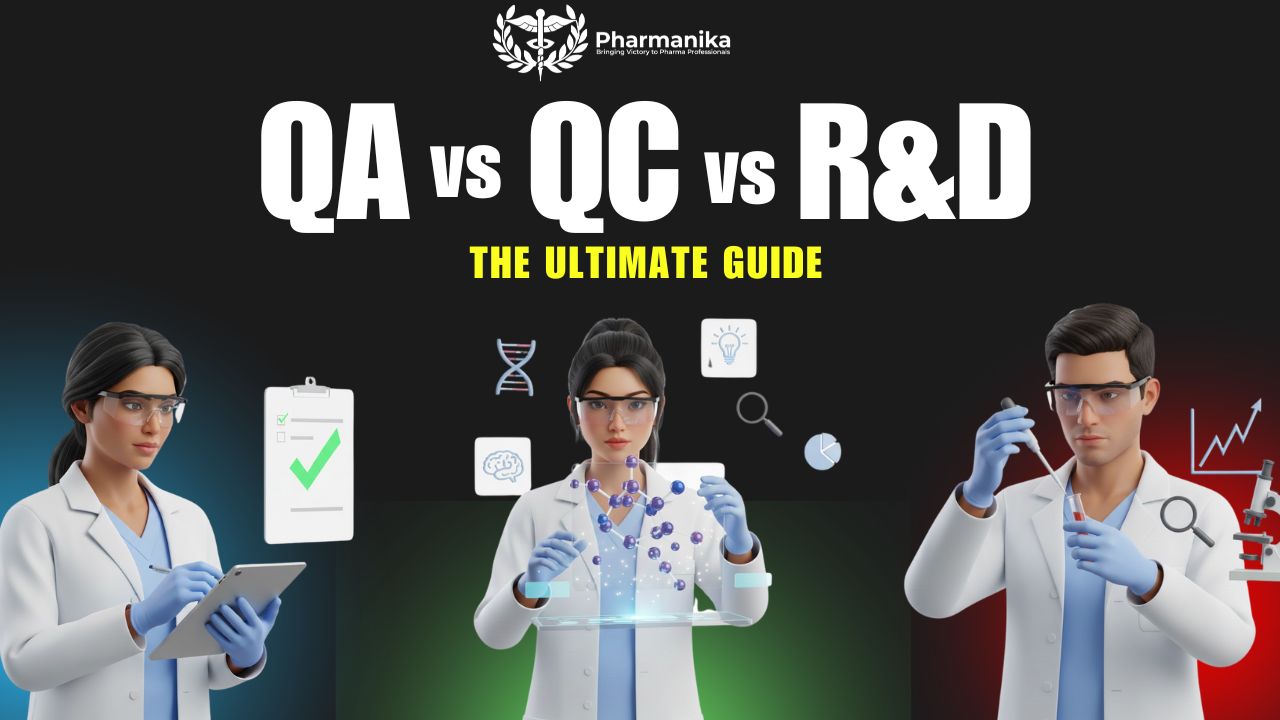
QC vs QA vs R&D: Roles, Work-Life Balance & Salaries Explained
If you are someone who has been applying for jobs in the pharma industry, you can always find that you often get confused between the different job roles in QC vs QA and R&D. And almost all the time, the difference is what will be running in your mind.
You can even see the HR departments in the company getting confused with the role you have applied for and the other roles that are advertised.
In this article, one thing will be clear to you: all the roles are completely different from each other. If you have seen a penguin, eagle, or ostrich, all are birds, but their characteristics are completely different. Similarly, the working style and responsibilities are all different in all 3 job categories.
This article will talk about all the job roles, the differences between QC vs QA, salaries, etc. We have curated this article for you to understand in simple terms. Let us look at it now.
Roles and Responsibilities
Quality Control (QC):
Professionals working in Quality Control Pharma are the final checkpoint for the products that are going out of the manufacturing plant. An analogy for this is when we exit a shop in the mall, there is a final check that is done. Similarly, the QC professionals also check for the quality of the product, the measurements of the ingredients, and check if everything is right to meet the regulatory standards.
The professionals will be involved in testing the products batch by batch, checking if the measurements are right, and they are the ones who approve or reject the products. Since they are in the final step, they always work on the finished products. We have always wondered if the medicine is safe or not, and these people make sure they are safe.
Quality Assurance (QA):
In the QC vs QA comparison, in the quality assurance pharma field, QA is actually different from QC. People working in this department don’t wait for products to be finished. They are one step above ensuring and designing the entire system to prevent mistakes from happening before starting the process itself.
These are the people who create procedures, write documents, train people, take care of process audits, and basically build a strong protection so mistakes don’t happen. These are some of the core QA responsibilities that professionals use on a daily basis.
A QA person spends their day writing standard operating procedures, conducting audits, analyzing data trends, and figuring out why things went wrong, and also thinking about how to stop it from happening again.
Research & Development (R&D):
Now, if you think about R&D people, they are the inventors. They live in an entirely different world. Professionals working in this department are scientists, engineers, and people who solve problems effectively. Unlike the other two, people in this sector work on something that doesn’t exist. They bring novel ideas to life.
Their work throughout the day is different from that of QA and QC experts, and these daily tasks form the core R&D responsibilities in pharma and biotech. They mostly work on experiments, run prototypes, and half of their day goes into failed experiments. Their day is mostly filled with one question, which is “What if we tried this?” If you did not know, these people spend most of their time reading research papers, running experiments, analyzing data, and trying to create the next big thing.
Most of their days are filled with experiments, prototypes, failed attempts, unexpected discoveries, and lots of “what if we tried this?” If you did not know, these people spend most of their time reading research papers, running experiments, analyzing data, and trying to create the next big thing.
Skills Required for the Job Roles
Quality Control
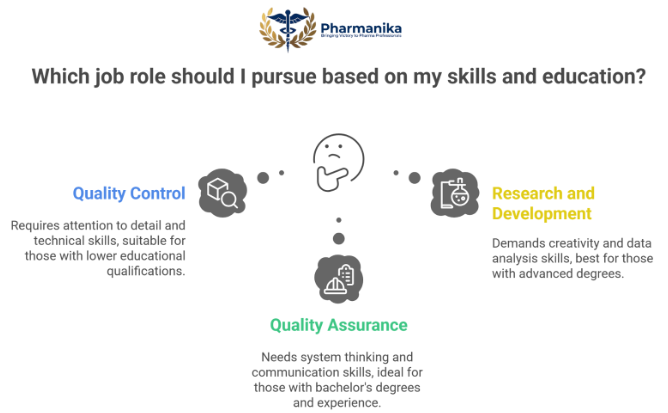
Understanding the skill requirements is crucial when deciding between QC and QA roles. Let’s break down what each field needs. There are so many opportunities that are open for people with an associate’s degree or even just a high school diploma. But in addition to your degree, it is always good to have some technical training and hands-on experience.
There is one skill that stands out, which is very important. To work in this department, attention to detail is very important. If you have seen it before, people working in this field look at even the tiniest detail to check for defects and variations. You should also be well-versed with lab equipment, measuring tools, and know about basic computer programs. You will also be documenting everything, so if you are someone who doesn’t like writing documents, then this might be difficult.
But there is one ray of hope for you: Almost all the companies train you on their specific equipment and procedures. They don’t expect you to be an expert at the time of your entry itself.
Quality Assurance
This sector requires a minimum of a bachelor’s degree in science, engineering, or a related field. But it is not always that people with these degrees get the job. Your experience can dominate the education, so it is always worth a try.
There are a few skills that will give you an upper hand over others. To work in a QA Lab, you need to think in systems. You should have questions like How do different processes connect? Where could things go wrong? In your mind. You should always imagine yourself as a detective who investigates problems even before they happen.
Another major component of jobs in QA is communication. You will be writing procedures, you will train people, present your reports to the management, and sometimes even talk to regulatory inspectors. If you are someone who can explain and communicate complex terms in simple language, then you will be an asset to the industry.
A few other skills that are a must include understanding of quality management systems (like ISO standards), data analysis skills, and the ability to stay calm when everyone’s panicking about the audit that is going to happen the next day.
Research and Development
For most of the R&D positions, the companies expect a minimum of a bachelor’s degree. But to be honest, just a bachelor’s degree is not enough; they prefer a master’s or a PhD, especially in pharma, biotech, or large tech companies.
But remember one thing, education is just the ticket for your entry. Along with education, it is really important for you to have the ability to think creatively, know how to handle failure, and have the ability to build small things, which gives a great final result.
A few important skills that a professional requires are designing experiments, data analysis, and statistical thinking. These are the skills that you would be using on an everyday basis. And you also need to know how to read a research paper and get the analytics right. Technical skills can be learnt from various sources, but it is very important to focus on soft skills as well, and they matter so much in your career.
Job Roles
As we spoke in the beginning, most people get confused about the job roles in QC vs QA, and they often think everyone has the same responsibilities. There are so many job roles at various hierarchy levels, and companies are still coming up with new roles every day.
Quality Control
QC responsibilities may vary from technician-level testing to senior-level method validation
- Quality Control Technician – This is the job role where most people start their career. This role involves tasks like running tests, recording the data, reporting, and documenting if there are any issues.
- QC Analyst – This is one step above the technician role. In this role, you will be testing the products, analyzing the trends of the product, seeing if there are any failures, and improving them. There is also another responsibility where you will be training the junior technicians.
- Senior QC Analyst/Specialist – If you are in this position, you will be the expert whom everyone will look up to. There will be complex problems put on your table, and you will be validating and analyzing new testing methods.
- QC Supervisor/Manager – From working under a manager, in this position, you would have moved to a place where you will be managing people and coordinating testing. There will be very few experiments that you will work on, and more spreadsheet working meetings will be held.
- QC Director – You have almost reached the top of the hierarchy. In this role, you will be looking after the entire QC department and will be involved in making strategic decisions.
Quality Assurance Career
QA responsibilities expand as you grow in your career, starting from documentation to handling audits.
- QA Associate/Coordinator – This is an Entry-level role. In this role, you will be supporting audits, maintaining documentation, and learning the ropes of quality systems.
- QA Analyst/Specialist – In this stage of your career, you will be owning the processes. There are various tasks involved in this role, like writing SOPs, investigating deviations, and conducting internal audits.
- Senior QA Specialist – In this role, you will be the expert in the room who will be handling various tasks. You will be handling complex compliance issues, leading major audits, and mentoring junior staff.
- QA Manager – You will be managing a team, interfacing with regulatory bodies, and making sure the whole quality system runs smoothly.
- QA Director/VP of Quality – This is a strategic leadership role. While working in this role, you will be looking after the quality of work from the entry level and you will also be dealing with a lot of pressure from regulatory guidelines and officials.
- Compliance Officer/Manager – This is a specialized role that mainly focuses on regulatory requirements. You can think of FDA, ISO, or any regulations your industry has.
R&D Career Path
- R&D Technician/Associate – In this role, you will start by supporting scientists by running experiments, maintaining equipment, and collecting data. If you are someone who is still figuring out your career, this is a great starting point.
- Research Scientist/Associate Scientist – As a scientist, you will be working in labs and setting up your own experiments.
- Senior Scientist – This role gives you a little more independence, and you will work on more complex projects. There is another responsibility of guiding and teaching the junior scientist and being part of the decision-making.
- Principal Scientist – You can work autonomously. You will be designing major studies, managing small teams, and you will be recognized as an expert in your area.
- Research Manager/Group Leader – This role requires a lot of management skills, as you will be managing people and coordinating multiple projects. There will be less bench work, and it will be more of a strategy and leadership.
- Director of R&D – You will be overseeing the entire research program. You will bethe one deciding what projects get funded, building teams, and aligning research with business goals.
- VP of R&D/Chief Scientific Officer – By now, you have reached the hilltop. You’ll be setting the entire research vision for the company.
Salaries and More
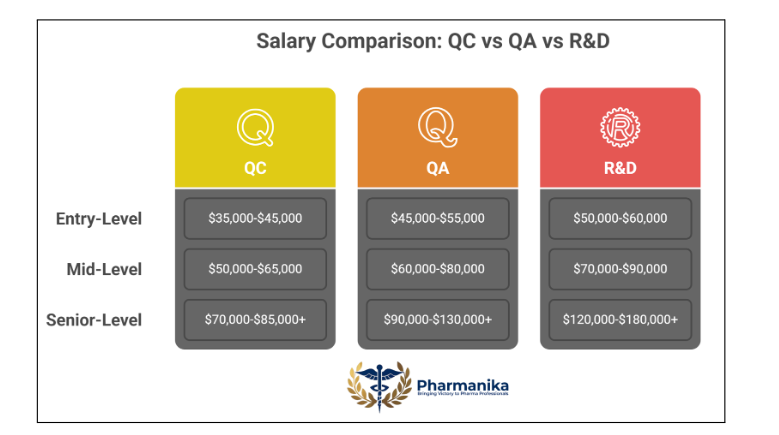
This is the most curious part that everyone will be interested in. The salaries given in this article are just rough ranges, according to recent statistics. They keep changing based on the industry, role, location, and experience, especially in the quality control pharma domain. When comparing QC vs QA salaries, QA generally pays better than QC because of the additional responsibilities.
QC Salaries
- Entry-level QC positions typically start around $35,000-$45,000.
- With a few years of experience, you can earn around $50,000-$65,000.
- Senior QC specialists or supervisors can get upto $70,000-$85,000 or more. It’s a solid and stable income
QA Salaries
- QA generally pays better than QC because of the additional responsibilities.
- Entry-level QA analysts start around $45,000-$55,000.
- Mid-level QA specialists earn $60,000-$80,000.
- Senior QA managers or directors take around $90,000-$130,000+.
There’s so much potential for your growth here. Especially if you move into management or specialized compliance roles.
R&D Salaries
- R&D compensation varies the most because it depends heavily on your education and the sector.
- An R&D technician might start around $50,000-$60,000. Research scientists with advanced degrees often get $70,000-$90,000.
- There is a most interesting part where principal investigators, or R&D directors in the pharma industry, will easily get around $120,000-$180,000+.
Which One Is Right for You?
Still confused about QC vs QA? Here’s a quick guide to help you decide based on your personality and career goals.
Go for QC if:
- You like hands-on work with clear procedures
- You are not bored with routine
- You want to enter the workforce quickly
- Stability matters more than excitement
Choose QA if:
- You’re organized and detail-oriented
- You like improving systems and processes
- Problem-solving gets you excited
- You want an opportunity for career growth
Pick R&D if:
- You’re genuinely curious and love learning
- You can handle uncertainty and failure
- You’re willing to invest in education
- Creating something new motivates you more than money
Conclusion
We have seen all the job roles, their roles and responsibilities, and how much the professionals earn. There is one more thing that no one focuses on, which is that these roles often overlap, and people move between one role and another during their career journey. You can start your career in QC, and if you realize you love to improve processes, you can move to QA. There is also a possibility that while working in QA, you can be pulled into product development discussions withthe R&D department.
None of these jobs is one better than the other, like the QC vs QA war. All of them are equally great career opportunities. They’re just different parts coming together to make sure products work, people stay safe, and companies stay competitive.
The most important thing is that you should choose a career that fits your personality, lifestyle goals, and ambitions. Because at the end of the day, you will be spending almost ¾ of your day doing work. You should pick something that you love doing, and that doesn’t make your life miserable.
Whichever career path you choose, you should always learn the skills that are in demand. As we are advancing in every field, companies will always look for curious people, updated about the field, and make things work the right way.