


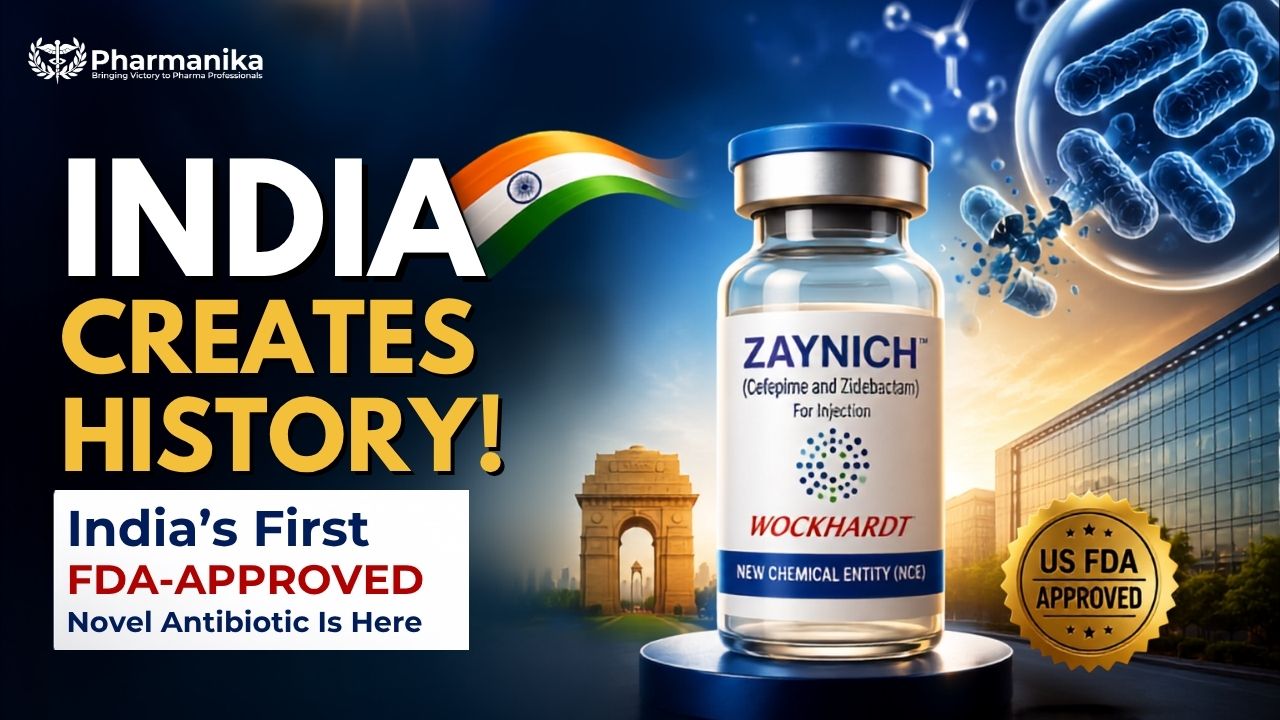
India Creates History! Wockhardt Develops India’s First FDA-Approved Antibiotic
India has always been known as the “Pharmacy of the World” as it supplies affordable generic medicines across the globe. However, most of these generic medicines are originally discovered by pharma companies outside India.
But now India has achieved something truly remarkable.
A Mumbai-based pharmaceutical company, Wockhardt, has created history by developing Zaynich, India’s first New Chemical Entity (NCE) antibiotic to receive approval from the US Food and Drug Administration (US FDA). This breakthrough is not just a proud moment for indian pharma but also a major advancement in the global fight against antimicrobial resistance(AMR).
What is Zaynich?
Zaynich is a new injectable antibiotic, which is developed by Wockhardt, used to treat complicated urinary tract infections (cUTI) caused by multidrug-resistant gram-negative bacteria.
Zaynich contains a completely new molecule called zidebactam, which makes it a New Chemical Entity (NCE), a drug molecule that has a medicine that never existed before in the world. Developing an NCE requires years of scientific research, laboratory studies, animal testing, and multiple phases of clinical trials before regulatory approval.
The growing threat of Antimicrobial Resistance (AMR)
Antimicrobial resistance (AMR) has become one of the biggest healthcare challenges worldwide. This occurs when bacteria change over time and become resistant to antibiotics that once killed them effectively. As a result, it becomes impossible to treat common infections.
- According to global health estimates:
- Around 1.27 million people die every year directly because of antibiotic resistance, and AMR contributes to nearly 5 million deaths annually.
- India ranks high among these due to excessive and inappropriate use of antibiotics.
What makes Zaynich different from other antibiotics?
The currently available antibiotics work by combining an antibiotic with another compound, which protects it from bacterial enzymes.
But Zaynich uses a completely different strategy, which combines cefepime, an established antibiotic, and zidebactam, Wockhardt’s newly discovered molecule.
Instead of simply protecting the antibiotic, zidebactam actively attacks the bacteria by targeting a different protein that is involved in the bacterial cell wall formation.
While cefepime blocks penicillin-binding protein 3 (PBP 3), Zidebactam binds strongly to penicillin-binding protein 2 (PBP2).
By attacking these two essential bacterial targets simultaneously, Zaynich makes it much harder for the resistant bacteria to survive.
Scientists refer to this innovative mechanism as the Enhancer Approach, which makes Zaynich different from currently available antibiotics.
Strong Results in Global Clinical Trials
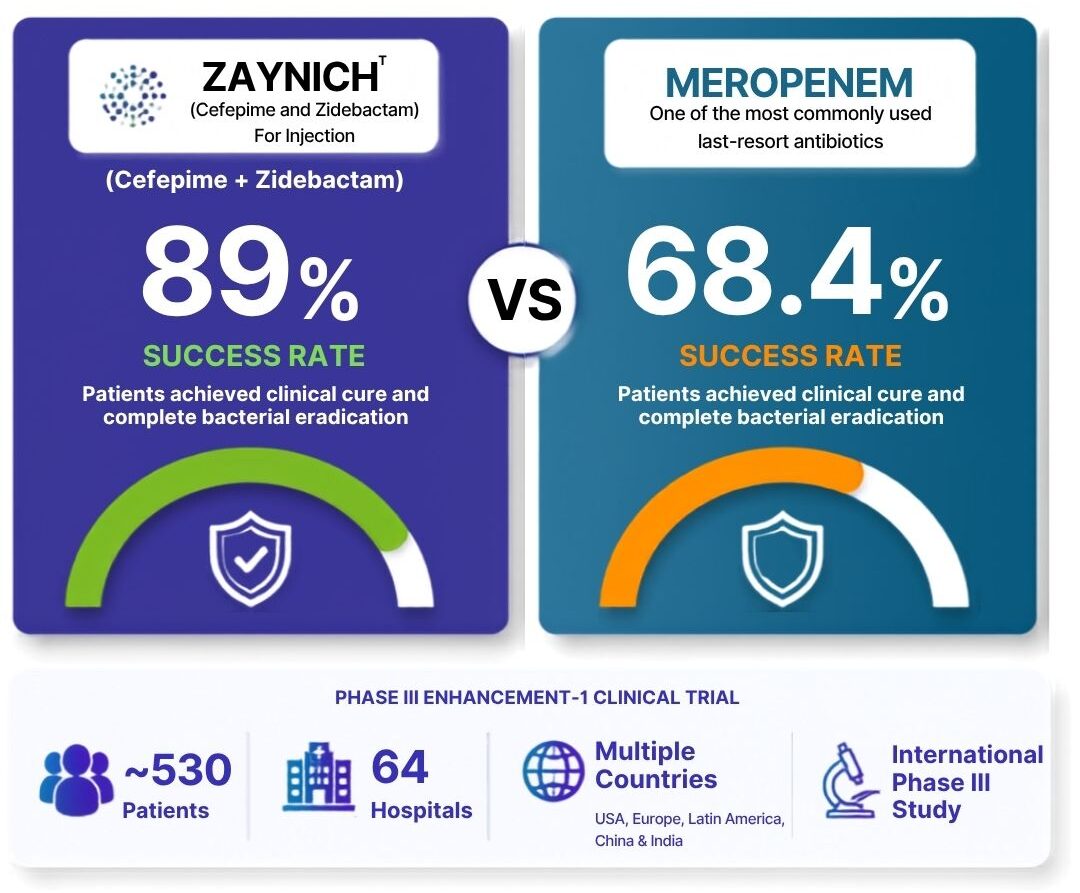
The effectiveness of Zaynich was shown during the international Phase III ENHANCE-1 Clinical trials.
This study includes almost 530 patients, 64 hospitals, and multiple countries, including the United States, Europe, Latin America, China, and India, where the results were encouraging.
Approximately 89% of the patients who received Zaynich achieved both clinical cure and complete bacterial eradication.
In comparison, only 68.4% of the patients treated with meropenem, one of the most commonly used last-resort antibiotics, achieved similar results. These findings suggest that Zaynich may become an important treatment option for serious drug-resistant bacterial infections.
The Long and Difficult Journey of Antibiotic Discovery
Creating a completely new antibiotic is one of the most challenging areas of pharmaceutical research. Scientists often screen millions of chemical compounds, but only a few show any activity against the harmful bacteria.
From those few candidates, many of them fail during the lab testing, others do not work in animal studies, and several fail during the human trials due to safety and effectiveness issues.
So developing a new medicine typically requires 10-15 years of research, hundreds of millions of dollars in investment, and multiple stages of regulatory evaluation.
Even after all the effort, there is no guarantee that the medicine will reach the market.
The Financial Challenges Behind the Antibiotic Discovery
Unlike diabetic or hypertension medicines, antibiotics are taken only for a few days.
In Addition, newly developed antibiotics are intentionally used only when absolutely needed to prevent bacteria from developing resistance too quickly.
Although this is medically essential, it also has sales limits. As a result, many pharma companies have reduced or completely stopped investing in antibiotic research, because financial returns are lower than in other therapeutic areas.
This makes Wockhardt’s achievement even more impressive.
The Next Challenge: Making this Drug Accessible
Although FDA Approval is a major milestone, ensuring patient access remains equally important.
Most of the experts believe that innovative antibiotics should reach patients who need them the most without unnecessary delays, since antimicrobial resistance is a growing public health emergency in India.
Affordable availability and responsible antibiotic use will be essential for maximizing the benefits of Zaynich.
Conclusion
Wockhardt’s Zaynich is much more than just another antibiotic. It represents the country’s growing scientific capability, years of dedicated research, and a significant contribution to global healthcare.
At a time when antimicrobial resistance threatens the millions of lives worldwide, and very few antibiotics are being developed, this achievement shows that indian pharmaceutical innovation can compete with global.
For Pharmacy students, researchers, healthcare professionals, and indian pharmaceutical industry, Zaynich is a powerful reminder that the future of drug discovery is no longer limited to Western pharmaceutical companies.
India has now proved that it can innovate, discover, and deliver world-class medicines to patients across the globe.