


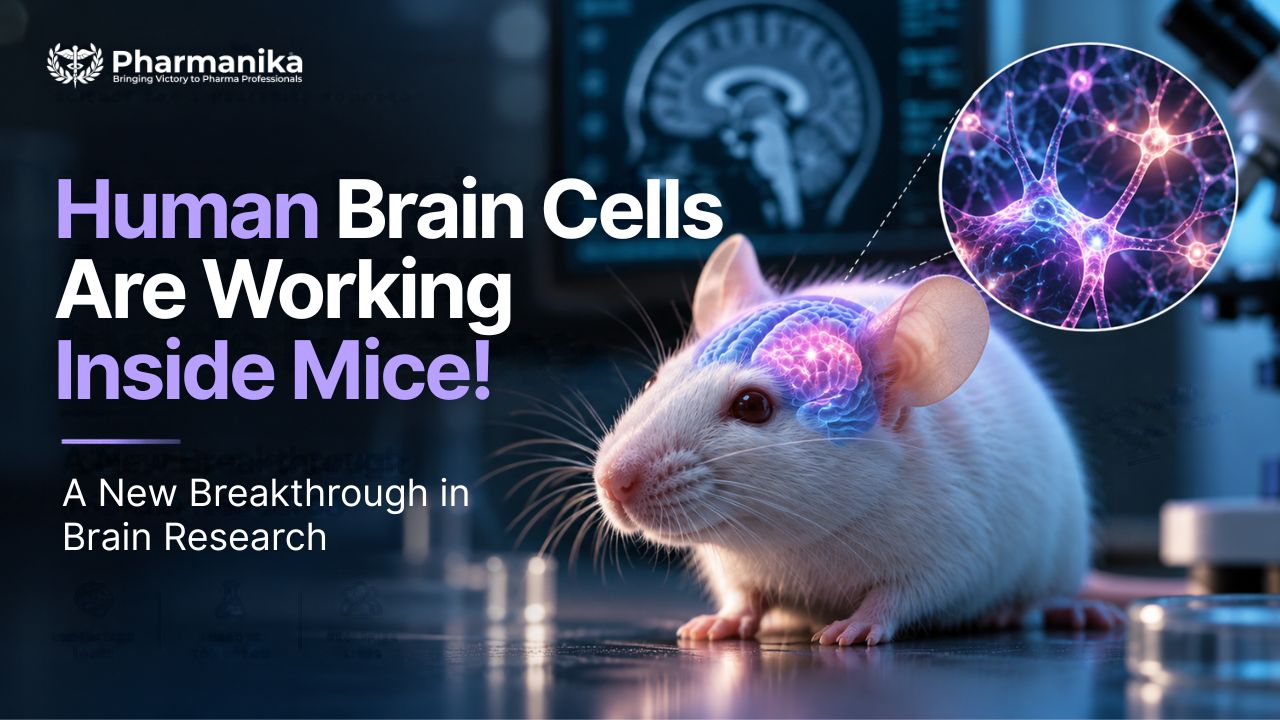
Mice With Human Brain Cells? Scientists Develop a New Way to Study Brain Diseases in a Major Breakthrough | Read the Full News Now!
Imagine researchers want to understand how human brain diseases work. They usually study using mice first, but the only problem is that a mouse brain is very different from a human brain. Some diseases that might affect humans don’t naturally occur in mice, so medicines that work in mice may later fail when tested in people.
To solve this problem, scientists at Stanford University have created laboratory mice with functional human brain cells in their brains, which could help researchers better understand human brain disorders and test new treatments more effectively.
This study was published in the journal Nature.
What did the scientist do?
As the scientists wanted to grow human brain cells inside a living mouse so that they could study them, they specifically changed the mice so that one part of the mouse’s brain did not fully develop. Then they took a normal human skin cell and reprogrammed it to grow into small pieces of brain-like tissue called brain “organoids”.
These organoids were implanted into the mouse’s brain, where the human cells survived, grew, and gradually connected with the mouse’s brain and nervous system.
The researchers did not create mice with complete human brains or human-like thinking. Instead, they created a new research model that allows scientists to study how human brain cells behave inside a living body.
What happened after the human cells were added
After the human brain cells were placed inside the mice, they survived and continued to grow. Over the next few months, these human cells started connecting with the mouse’s own brain cells and nervous system.
After about 6 months, the scientists observed and tested the mice and their basic behavior. They found that the mice were able to move and behave logically, like normal mice, even though part of their brains contained functioning human cells.
Did the mice start thinking like a human?
No, even though the mice had functioning human brain cells, they did not start thinking or behaving like humans. About six months after the experiment, scientists tested their basic behavior and found that they behaved mostly like normal mice. They did not show any unusual intelligence or enhanced abilities. The researchers explained that adding human brain cells does not turn a mouse brain into a human brain. The animals were still mice, with only some human brain tissue growing and working inside their brains.
What was interesting about the study?
Scientists did this to find a better way to study human disorders. Mice are commonly used to test new treatments, but their brains are different from human brains, and some human brain conditions cannot be studied properly in mice.
By growing human brain cells inside a living mouse, researchers can observe how these cells develop, connect, and function in a living body. They hope this approach could help them better understand conditions like epilepsy, autism, and cerebral palsy and improve the way potential treatments are studied.
Why are there ethical concerns
This type of research also raises some important ethical questions. For example, if scientists continue adding more human brain tissue into animals in future studies, could it eventually change how these animals think, feel, or experience their surroundings?
There is currently no evidence that this happened in this study;
However, experts say that such research must be carefully monitored to make sure animal welfare and ethical limits are properly considered.
What could this mean for the future?
The biggest advantage of this research is that it could give scientists a better way to understand human brain diseases. Instead of depending only on normal mouse models or cells grown in a laboratory dish, researchers can now study how human brain cells behave inside a living nervous system.
This may help scientists better understand brain disorders and improve the way new treatments are tested before they reach human clinical trials.
In simple terms, scientists have not created a half-human mouse. They have created a mouse with some functioning human brain cells to help researchers study human brain diseases in a more realistic way.
Interested in understanding how discoveries move from preclinical research to human clinical trials? Explore the Advanced Clinical Research Training Program by BioTecNika.